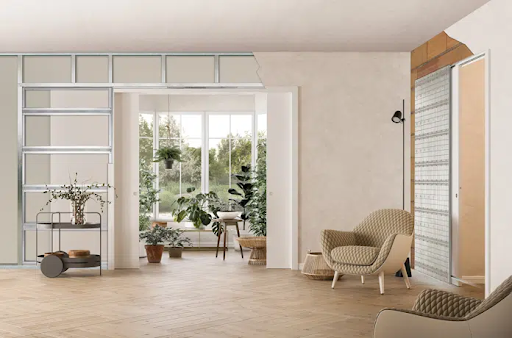
Some rooms never quite work, no matter how often they are rearranged. Furniture feels slightly off. Walkways narrow unexpectedly. Corners stay empty for no obvious reason. These spaces are often described as awkward, as if the problem were abstract or unavoidable.
In reality, awkward layouts usually have a cause. It just tends to be overlooked because it feels permanent. Walls, windows, and doors are accepted as fixed facts, even though they quietly dictate how a room can function.
Doors are especially influential. Their position, swing direction, and clearance zones shape circulation long before furniture enters the picture. When a door opens into the wrong part of a room, it can steal the only logical spot for a bed, desk, or sofa. The room adapts around the door, not the other way around.
This is why layout problems often persist through multiple furniture changes. The root constraint never moves. People learn to live with odd angles and compromised arrangements, assuming the room itself is flawed.
The shift happens when the door is questioned. Not the style or colour, but its behaviour. Does it need to occupy floor space when open. Does it need to claim a wall edge permanently. Does it need to be visible when not in use.
For many problem rooms, sliding pocket doors address these questions directly. By removing the swing arc entirely, the door stops competing with the layout. The wall becomes predictable. Circulation paths simplify. The room gains at least one full edge that can finally be used.
This is particularly noticeable in secondary bedrooms, narrow studies, and oddly shaped living areas. Once the door disappears into the wall, the space stops feeling defensive. Furniture can be placed for function rather than avoidance. The room begins to respond to how it is actually used, not to a permanent obstacle that demands accommodation.
Bathrooms offer another clear example. In small or irregular bathrooms, a swinging door often clashes with fixtures or blocks sightlines. Removing that motion can instantly make the room feel more resolved, even if its footprint remains unchanged. Entry and exit become simpler, and daily routines stop revolving around a moving panel.
The benefit is not just about space, but about choice. When the door no longer dictates where things cannot go, homeowners regain control over the layout. That flexibility often reveals that the room was never too small or badly designed. It was simply constrained. Once freed, the space tends to settle into a more intuitive arrangement.
This solution is often discovered late. People arrive at it after trying everything else. New furniture. Custom storage. Even partial renovations. Only then does the door come under scrutiny, not as a style element, but as a structural influence.
Part of the hesitation comes from the assumption that pocketed systems are complex or fragile. Modern hardware has largely solved those concerns, but the perception lingers. As a result, doors are treated as background elements rather than strategic ones. They are installed, then forgotten.
Yet in rooms that refuse to cooperate, the door is often the missing variable. Changing it does not require expanding walls or moving windows. It requires rethinking how movement happens in the space. Once that shift is made, the room often works with surprising ease.
When a room suddenly starts to make sense, the fix can feel disproportionate to the effort. The same walls. The same size. A completely different experience. That is the hallmark of a structural issue finally being addressed.
In many homes, sliding pocket doors are not a stylistic upgrade. They are a quiet correction to a problem that was always architectural. Once the door stops getting in the way, the room is finally allowed to work the way it should.
Be the first to comment on "The Hidden Fix for Awkward Room Layouts"