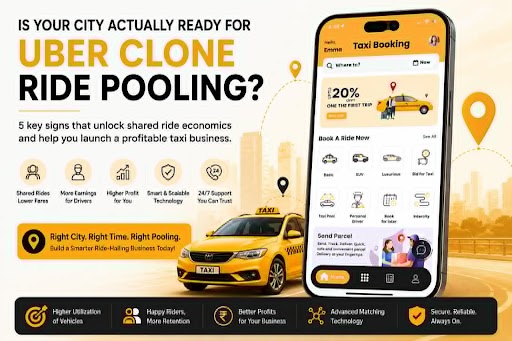
Starting a taxi business in a new city with the help of an Uber clone app without understanding what the gaps in the city transportation are is like opening a restaurant without the food culture of the city.
To be specific, ride pooling is more complex than a standard taxi booking app feature wise and that’s why it depends more on the technical side of the app. Most new businesses treat the pooling features as a checklist, which they have successfully managed to launch. They see the feature, understand the flow, launch with minimal marketing, and then watch the booking fail to come.
To be honest, shared transportation works when some highly specific conditions are met or they already exist in a new city, and if you want to white label your way to launch your business, then ride pooling does need some extra attention. This is the real work.
Understanding the role of Urban Density in Ride Pooling
Ride pooling, which is also known as carpooling or shared rides, basically depends on matching a lot of coincidences on a larger scale. Two riders in the same area need to want a pickup, travel towards overlapping destinations, and both of them should be okay with a slightly longer journey.
When these conditions happen frequently in a new city, the business profit becomes very attractive. A taxi booking app that successfully manages to launch pooling under these conditions can stop riders from leaving, keep drivers busy, and lower the average cost per kilometer.
The global market reached an estimated USD 406.52 billion in 2026, which is mainly driven by riders wanting to save money by choosing shared rides in highly crowded areas of the city. But here is the part that the sales pitches skip.
Ride pooling fails badly in a city where people are spread out. Your tech team can get the algorithm perfectly right on the technical side of the app, but the feature will still fail to get bookings if the city does not have enough people requesting trips on the same routes at the exact same time. Because as complex as it is feature wise, route overlapping is also a population behavior problem.
Even big players like Uber have stopped their pooled rides in certain markets simply because there were not enough riders to match the trips properly. Founders who are starting a ride-sharing business need to understand this reality of the city before spending too much of their resources to build the pooling infrastructure.
Five Signs Your City Has Reached Ride Pooling Viability
-
High-Volume Traffic
Ride-hailing grows in a city mainly because these busy routes exist and stay jammed with traffic all day. Last year, people in America lost around 63 hours just sitting in traffic, which costs billions. These crowded routes are exactly where pooling brings real value for riders who want to save money.
-
Affordable Fair Over Convenience
The second thing is how much your riders care about the fare. If people in your city always pick the cheapest ride, even when a faster private cab is right there, they probably have the patience that ride pooling needs. Normally, shared rides add about five to fifteen minutes to the trip.
A rider who doesn’t want to pay ten percent more will definitely accept a longer ride just to pay less. This is a customer habit that you can easily check from the booking data of your white label Uber clone app before you even focus on the technical side of the pooling features.
-
Smartphone Use Among Adults
To be specific, ride pooling depends heavily on how people use their smartphones. Matching two riders in real time means both of them need to have active GPS, reply to notifications fast, and trust the technical side of the app to handle the coordination perfectly. New businesses that ignore this often see high cancellation rates because one passenger just doesn’t respond quickly during pickup.
In 2026, more than 80 percent of people in major cities have smartphones, and this is exactly what makes app-based shared rides possible. If you are launching your ride-sharing business in a city where fewer people use smartphones, pooling should be on your future checklist, not something you launch on day one.
-
Recurring High-Density Travel
The fourth point is about when people actually travel. Cities that have two or three major rush hours, like morning and evening office times, create the perfect timing that ride pooling needs to work. A taxi booking app in a city where bookings just trickle in evenly throughout the whole day will struggle to match riders successfully. So, pooling only works when you have enough volume. Founders need to look at the hourly booking flow before spending a lot of time and money building the pooling features.
-
Public Transport Along App-Based Rides
The fifth and probably the most ignored point is the culture of the city when it comes to shared transportation. If the new city already has a culture where people use buses, walk a bit, and take cabs, they are already open to sharing vehicles. These riders know that traveling with strangers is a normal thing.
Does Ride Pooling Bring Profits to Your City and Business too?
Truthfully, when ride pooling is launched in the right environment, it does a lot more for your white label Uber clone app than just lowering the fares for riders. It basically makes it cheaper and easier for your drivers to get their next ride. To be specific, a driver doing a pooled trip earns money from two bookings while only driving one route.
Because drivers spend more time actually carrying passengers instead of waiting around for requests, they stay busy and don’t leave your platform. This reduces your cost of finding new drivers and increases your overall business profit. Pooling is more complex feature wise than a standard taxi booking meaning it doesn’t just copy the standard features at a cheaper price, it actually changes the entire business model on the technical side of the app.
Riders who first start using your app because of the affordable shared rides will eventually start booking solo private cabs for specific trips, like an airport drop or coming home late at night. People want affordability and convenience, and pooling perfectly fills these gaps in the city transportation, but only if those five specific conditions we talked about already exist in the new city.
Final Thoughts
Most new businesses that white label their way to launch and add pooling prematurely just because it is in the Uber clone script end up wasting a lot of time on the technical side. Even worse, they train their early riders to associate the app with bad matching and long waits, and then watch the booking fail to come. But if you launch it at the exact right moment i.e. when the city’s density, route overlap, smartphone habits, and transport culture all align perfectly, you are unlocking one of the most powerful tools available to grow your taxi business.
FAQs
- How to know when a city has enough demand to support shared rides?
You just need to look at your booking data along the same routes over a few weeks. If a lot of your trips are starting and stopping in the same areas during rush hours, the matching on the technical side of the app will actually work.
- How can you tell if riders in a new city will even like shared rides?
The biggest clue is how they already travel. If they are used to taking buses, walking a bit, and using cabs, they are already okay with the idea of traveling with strangers. This culture of the city makes it way easier to launch your pooling business compared to a place where everyone just wants to drive their own private car.
- Does enabling shared rides on your app actually help drivers earn more?
It mostly depends on how well the trips match feature wise. When a driver can pick up two riders on the same route, they stay busy making money instead of waiting around for their next request. In a city where this works well, drivers are happy and won’t leave your platform.
- Should a new ride-hailing business launch with ride pooling feature from day one?
Honestly, most new businesses should start with standard solo rides first. This helps you understand the gaps in the city transportation and build up your daily bookings. Once you have enough volume, then you can give pooling the extra attention it needs.
Be the first to comment on "5 Signs That Show Your City Is Ready for Uber Clone Ride Pooling"