Picture this: you hold up your phone in a furniture store, and suddenly a 3D couch appears in your living room. It fits perfectly—at least on screen. Or think of a factory worker wearing smart glasses that highlight the exact pipe he needs to fix. Feels like magic, right?
But here’s the truth: Augmented Reality (AR) only holds when latency, bandwidth, synchronization, and consistency all align perfectly — powered by data movement.
Every frame, every depth calculation, every object interaction is the result of thousands of bits racing between sensors, servers, and displays. If any link stutters even for a split second, the ghost object jitters or disappears completely.
That’s why the true foundation of AR is its network architecture underneath. Peek behind, and you find those old-school OSI model layers, buffer strategies, adaptive codecs, and every protocol in between. These “boring” fundamentals become the bedrock upon which wonder is built.
So, First Things First: What is AR?
Let’s clear this up. What is AR? Augmented reality isn’t about replacing your world—that’s Virtual Reality (VR)’s job.
Instead, it layers digital stuff on top of reality—filters on Snapchat. Pokémon GO creatures are popping up in the park. Navigation arrows hovering over the street through your windshield.
The key? It has to feel instant. The moment there’s lag—your head turns and the overlay takes a beat to catch up—the spell is broken. And in high-stakes settings (think doctors in surgery or technicians repairing machinery), lag isn’t just annoying. It’s dangerous.
Why AR Is Brutal on Networks
AR isn’t light browsing or a Zoom call. It’s demanding. It wants more from your network than typical apps:
- Big bandwidth. Streaming 3D models or real-time video feeds isn’t small potatoes.
- Zero patience for delay. A half-second lag is enough to make people dizzy or to ruin precision work.
- Uninterrupted reliability. You can’t have an AR navigation system cutting out mid-drive.
That’s why the network infrastructure under AR is almost more important than the app itself.
OSI Model Layers — The Quiet Backbone
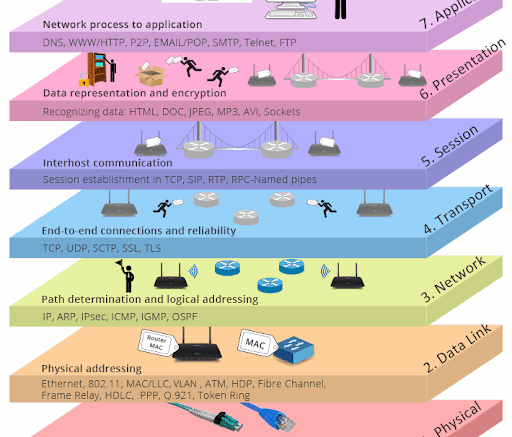
Here’s where the nerdy part sneaks in. The OSI model layers sound like textbook filler, but if you strip them out, AR falls apart. Each one quietly does its job so you can chase monsters in your park or a surgeon can trust an overlay mid-procedure.
Here’s the crash course:
- Physical layer. The wires, fiber, or 5G signals carrying all that heavy AR data. If this is weak, nothing else matters.
- Data link. Like air traffic control, making sure packets don’t crash into each other.
- Network. Gets AR data from point A to point B — and back again — without detours.
- Transport. Keeps everything in order. Imagine AR instructions arriving scrambled. Useless.
- Session. Maintains the “conversation” between your device and the server. Drop this, and your AR session collapses.
- Presentation. Converts raw code into images, models, or overlays you can actually see.
- Application. The AR app itself — the flashy front-end we interact with.
All invisible, all essential. AR isn’t possible without them.
Where Networking Really Shows Up in AR
Take it out of theory. Here’s where you notice network strength (or weakness):
- Retail. Customers trying clothes virtually won’t stick around if the mirror lags. Smooth networks = higher sales.
- Healthcare. Surgeons relying on AR guidance need updates in real-time. A dropped packet could cost lives.
- Manufacturing. Step-by-step AR assembly instructions break down if Wi-Fi hiccups. That means downtime and errors.
- Gaming. AR thrives on immersion. Laggy monsters? They disrupt gameplay and break the user experience.
In every case, the app isn’t what kills the experience. The network is.
Edge Computing to the Rescue
Here’s the good news: networks are catching up. The rise of 5G and edge computing means AR data doesn’t always have to make the long trip to a faraway cloud server. Instead, it gets processed closer to you, then served back almost instantly.
For AR, that’s the difference between “cool demo” and “actually usable.”
The Bumps in the Road
Still, it’s not perfect. Some issues hang around:
- 5G isn’t everywhere. Coverage gaps mean inconsistent lags, dropped frames, or even complete interruptions in AR experiences, especially in rural or densely built-up areas.
- Devices have limits. Phones and AR headsets overheat or drain fast when pushing all this data. Example: real-time 3D rendering, computer vision, etc.
- Standards vary. Not every AR tool or network fully supports the same protocols or APIs, which can lead to compatibility issues, interoperability problems, and development complexity.
And that’s where going back to OSI basics matters. If you know the framework, you can pinpoint:
- Is it the physical layer (bad coverage)?
- The session layer (dropped connections)?
- The presentation layer (device can’t keep up)?
It gives you a map for solving problems and optimizing AR deployments.
Wrapping It Up
So, the next time someone asks, what is AR — don’t just talk about the cool graphics. Think about the invisible gears underneath. The protocols. The bandwidth. The OSI model layers quietly doing the grunt work.
Because augmented reality doesn’t run on magic. It runs on strong networks. And when the foundation is solid, that’s when the magic actually feels real.
Be the first to comment on "How Augmented Reality Relies on Strong Network Foundations"