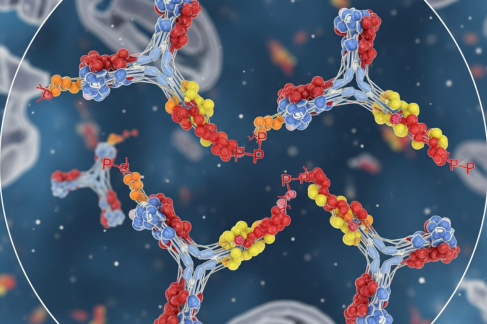
Our body is made up of trillions of cells. Each cell must communicate with others to keep us alive and healthy. This communication allows our body to perform complex tasks like breathing, healing, thinking, and moving.
Cells pass information using chemical signals. These signals often come in the form of hormones, neurotransmitters, or growth factors. When such a signal reaches a cell, it binds to a receptor on the cell’s surface. This receptor then activates a chain of events inside the cell, known as a signaling pathway.
These pathways depend on proteins to pass messages. They add and removing phosphate groups from a protein. This process is known as phosphorylation. It acts like a molecular switch that turn protein on or off depending o how a cell should respond.
For instance:
- When you are injured, phosphorylation helps activate proteins involved in healing.
- When you eat, it helps control how your body processes sugar.
- When you learn something new, it helps strengthen memory pathways.
Without phosphorylation, cells won’t know when to grow, divide or repair themselves. As a result, this can lead to various diseases, including cancer, diabetes and nerve disorders.
Since phosphorylation affects how proteins work, measuring phosphorylated proteins helps scientists understand cell activity. It helps:
- Study Cell Signaling Pathways
- Detect Abnormal Activity in Diseases
- Evaluate Drug Effects
- Monitor Cellular Processes
Scientists and researchers use phospho antibodies to detect and measure the phosphorylation state of proteins. Phospho antibodies are specialized antibodies designed to recognize proteins only when they are phosphorylated at specific amino acid residues such as serine, threonine, or tyrosine. These antibodies are designed to distinguish between a phosphorylated and a non-phosphorylated version of the same protein.
They help understand:
- Cell communication
- Signal transduction
- Enzyme activity
- Disease progression
However, with endless numbers of phospho antibodies and suppliers available, choosing the right antibodies can be challenging.
How to Choose the Right Phospho Antibody for Your Research?
Know Your Research Goals
Before you buy phospho antibody, it is vital to define your research goals. Ask yourself questions like:
- Do you want to study a signaling pathway or a specific protein’s activation?
- Do you want to compare phosphorylated versus total protein levels?
- Is you focus on qualitative or quantitative analysis?
Having a clear goal helps narrow down which antibody type and specificity you need. For instance, if you want to study the MAPK signaling pathway, you may need phospho-specific antibodies that detect ERK1/2 when phosphorylated at Thr202/Tyr204.
Check Site Specificity
Phosphorylation occurs at specific amino acid residues on a protein. A good phospho antibody should be site-specific – it means antibodies should recognize only the phosphorylated form at a particular site.
So, when buying phospho antibodies, check:
- The phosphorylation site, such as Ser473 or Tyr705
- Whether the antibody has been validated to detect that site in your target protein
For instance, in the case of AKT signaling, phospho-AKT (Ser473) and phospho-AKT (Thr308) antibodies detect two different phosphorylation event. So, if you use the wrong one, it can leads to misinterpretation of results.
Evaluate Species Reactivity
Proteins often have similar structures across species, but small differences can affect antibody binding. Always check whether your phospho antibody has been validated for the species you are working with — human, mouse, rat, zebrafish, etc.
Manufacturers usually provide a list of tested species. However, if your species is not listed, look for antibodies that show high sequence homology at the phosphorylation site. Some vendors also provide cross-reactivity data or sequence alignments that can help in decision-making.
Consider the Application
Not all phospho antibodies work well in every application. Some perform better in Western blotting, while others are ideal for immunohistochemistry (IHC), immunofluorescence (IF), or flow cytometry (FC).
Check the product datasheet for application validation. For example:
- Western blot: Tests protein size and phosphorylation status.
- Immunohistochemistry: Detects phosphorylated proteins in tissue samples.
- Immunofluorescence: Shows cellular localization of phosphorylated proteins.
- ELISA: Quantifies phosphorylation levels.
If the antibody is not validated for your technique, results may be weak or non-specific.
Check for Cross-Reactivity and Specificity
One of the biggest challenges with phospho antibodies is cross-reactivity, where an antibody binds to non-target proteins or non-phosphorylated forms of the same protein. This can lead to false positives and poor reproducibility.
To ensure specificity:
- Look for antibodies that have been tested against dephosphorylated or mutant controls.
- Prefer antibodies raised using phospho-peptides that exclude non-phosphorylated epitopes.
- Choose monoclonal phospho antibodies for higher specificity, though polyclonal ones may detect multiple phosphorylation forms.
The Bottom Line
Choosing the right phospho antibody is crucial for an experiment. Otherwise, you may get inaccurate results. You can consider the aforementioned tips to buy phospho antibodies. However, apart from this, from where you buy your tools also affects your results. So, make sure you buy high-quality phospho antibodies from a reliable source, like AAA Biotech.
Be the first to comment on "How to Choose the Right Phospho Antibody for Your Research Needs?"