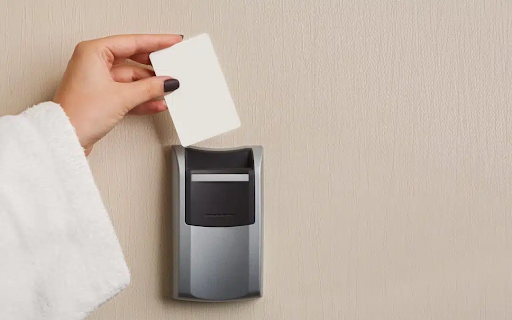
A magnetic stripe hotel key card looks like a simple piece of plastic, but there is a precise chain of technology happening every time a guest swipes it at their door. That chain involves magnetic particles, binary encoding, electrical signals, and a lock processor, all working together in under a second.
For hotel operators, understanding how that process works is directly useful. It informs which cards to buy, why failures happen, and what separates a card that holds up through a full stay from one that stops working on day two.
What is a Magnetic Stripe Hotel Key Card?
A magnetic stripe hotel key card is a plastic card with a thin band of iron-based magnetic particles on its surface that stores encoded guest access data, read by a card reader at the door lock to grant or deny entry.
The card itself is standard credit card size, made from PVC, with the magnetic stripe running along the top or bottom edge on the back. It contains no battery, chip, or antenna. It is entirely passive, and data is stored purely through magnetism.
The technology traces back to IBM engineer Forrest Parry, who first affixed magnetic media to a plastic card for identity storage. Hotels adopted it as a major upgrade from metal keys and hole-punch cards, and it has remained the backbone of hotel access management ever since.
What is Actually Inside the Magnetic Stripe?
The magnetic stripe contains millions of tiny iron-oxide particles that can be magnetized in two directions to represent binary data. The stripe is divided into three tracks, each storing a different type of information.
At a physical level, each particle aligns either north or south when a magnetic field is applied, representing a 0 or a 1. Those billions of tiny alignments are what hold your guest’s access data.
The three tracks serve distinct purposes:
- Track 1 stores alphanumeric data with the highest capacity, originally designed for cardholder names in banking applications
- Track 2 stores numeric data only and is the most commonly used track in hotel lock systems
- Track 3 is fully rewritable and is where hotels encode the guest’s room number, check-in date, checkout date, and access permissions
The data written to the stripe is not a plain-text room number. It is an encrypted access code generated by the hotel’s lock system and matched to a specific room for a specific stay. That encryption is what makes the card functional only at the right door during the right time window.
How Does the Card Get Programmed at Check-In?
At check-in, a front desk encoder uses an electromagnetic write head to magnetize the particles on the card’s stripe in a specific pattern corresponding to the guest’s room, access level, and checkout date.
The entire encoding process takes seconds. The encoder is connected to the hotel’s property management system, which generates a unique access code per guest per stay and pushes it to the write head. The head passes over the stripe and sets the magnetic alignment of the particles to match the required pattern.
Any previous data on the stripe is overwritten completely during this process, which is why the same physical card can be reused and reprogrammed for a new guest without any issues. It also means lost cards can be deactivated instantly by simply issuing a new card for the same room, which overwrites the access credential in the system and renders the old card useless at the door.
How Does the Door Lock Read the Card?
When a guest swipes or inserts the card, a magnetic read head inside the door lock detects the polarity changes along the stripe, converts them into electrical signals, decodes the access data, and verifies it against the room’s current valid credential.
The whole verification process completes in under one second. Here is exactly what happens at each stage.
Step 1: The Card Is Swiped or Inserted
The guest slides the card through the reader slot on the door lock. The direction and speed of the swipe move the stripe past the read head inside the reader.
Step 2: The Read Head Detects Magnetic Signals
As the stripe passes over the read head, the head picks up the changing magnetic polarity of each particle along the track. Each polarity change generates a small electrical pulse.
Step 3: Signals Are Converted Into Data
The pulses are translated into a binary sequence corresponding to the encoded access code. This conversion happens within the lock’s internal processor.
Step 4: The Lock Verifies the Code
The decoded data is checked against the access credential programmed for that room. The lock also checks whether the current date falls within the valid stay window.
Step 5: Access Is Granted or Denied
If the code matches and the stay window is active, the lock releases and the door opens. If the code is incorrect or the checkout date has passed, access is denied, and the guest needs to return to the front desk for a new card.
No internet connection is required at any point. The entire verification happens locally within the lock hardware, which is why hotel key card systems continue to function even during network outages.
HiCo vs LoCo: What Is the Difference?
HiCo (High Coercivity) stripes require a stronger magnetic field to encode and are far more resistant to accidental erasure. LoCo (Low Coercivity) stripes encode more easily but demagnetize much more readily from everyday exposure.
HiCo cards are identified by a black or dark brown stripe. LoCo cards carry a lighter brown stripe. The difference matters significantly in a hotel environment where cards are tucked into pockets next to phones, stacked in wallets, and handled dozens of times before checkout.
For most hotel operations, HiCo is the right choice. The cost difference between the two is minimal, but the operational cost of card failures at the door, including front desk time, guest frustration, and reissue rates, adds up quickly. Quality manufacturers like Plastilam produce flush-laminated HiCo stripes that are embedded within the card surface rather than applied on top, which adds another layer of protection against wear over time.
How Secure Is a Magnetic Stripe Hotel Key Card?
Magnetic stripe hotel key cards provide reliable access security through encrypted credentials, time-bound access windows, and instant remote deactivation.
Encrypted Access Codes
The data on the stripe is a proprietary, encrypted code generated by the hotel’s lock system, tied to a specific room and stay, and readable only by the door hardware it was programmed for. Without the matching system, the data on the stripe means nothing.
Time-Bound Access
Every card is programmed with a checkout date baked into the access credential. Once that window closes, the card stops working automatically at the door with no manual step required from the front desk, and no risk of lingering access after a guest departs.
Instant Deactivation
Issuing a new card for a room immediately invalidates all previously issued cards for that stay. The entire process takes seconds at the front desk, with the old card rendered inactive and the new one ready to use before the guest reaches their floor.
No Personal Data on the Card
Guest names, payment details, and ID information are never stored on the stripe itself. All personal data stays entirely within the hotel’s internal property management system, keeping guest information off the card and out of reach.
For a technology that has been in use for decades, magnetic stripe delivers a practical security framework, fast to manage, and built around the realities of daily hotel operations.
FAQs
Can a hotel key card demagnetize your credit card?
Yes, but only through direct and sustained contact. Storing a hotel key card pressed against a credit card in a tight wallet over time can cause interference between the two stripes, potentially corrupting data on either card.
Does a hotel key card store personal guest information?
No, magnetic stripe hotel key cards store only an encrypted access code tied to a room and stay window. Personal guest information, such as name, payment details, and ID data, stays within the hotel’s property management system, not on the card itself.
Why does my hotel key card stop working near my phone?
Smartphones contain small magnets in speakers, cameras, and cases that can weaken or erase the magnetic stripe on a hotel key card. LoCo cards are especially vulnerable. Keeping the card in a separate pocket away from your phone is the simplest way to avoid this.
Bottom Line
What looks like a simple plastic card is a precise piece of technology that depends on material quality, encoding accuracy, and correct card selection to perform reliably every single time. The magnetic stripe stores encrypted access data, the front desk encoder writes it in seconds, and the door lock reads and verifies it in under a second without any network connection involved. Choosing the right card technology, the right coercivity level, and a manufacturing standard built for hospitality is what keeps that moment seamless every time.
Plastilam is a US-based manufacturer of magnetic stripe and RFID hotel key cards serving boutique and independent hotels across the country. Every mag stripe card is built with flush-laminated HiCo stripes for consistent performance and longer card life, available in both pre-designed and fully custom options to match any property’s brand standards.
If you’re looking for hotel key cards built to perform, call 800-600-3088 to get a quote and find the right card for your property.
Be the first to comment on "How Does A Magnetic Stripe Hotel Key Card Actually Work?"