Ask this question in a Facebook group for founders and you’ll get answers ranging from “I built mine for $500 on Fiverr” to “we spent $400,000 and it still wasn’t finished.” Both are true stories. Neither tells you much about what you should expect to pay, because they’re describing completely different projects wearing the same label.
A mobile application development company doesn’t quote off a price list the way a printer quotes business cards. Every number comes from a specific combination of platform, features, backend complexity, team location, and timeline pressure, and changing any one of those variables can shift the final cost by tens of thousands of dollars. This isn’t evasiveness on the industry’s part. It’s just how custom software pricing actually works. Here’s a real breakdown of what’s driving costs in 2026, with numbers attached rather than vague ranges.
App Complexity Is the First Thing That Sets the Price
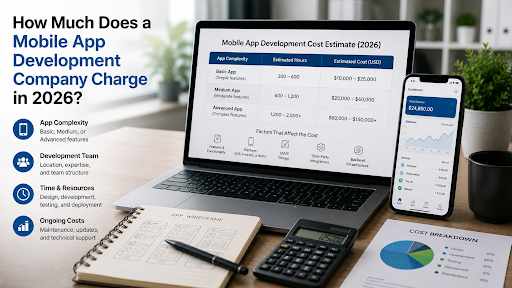
Start with the basic split that matters most: simple versus complex. A basic app, a handful of static or semi-static screens, no user accounts, minimal backend logic, typically runs $8,000 to $25,000. Think a restaurant’s menu and ordering app, a single-business loyalty card, an event schedule app for a conference. The work is mostly frontend, the timeline is usually six to ten weeks, and most of the cost is design and screen-building rather than backend engineering.
A standard business app moves into different territory. User accounts, a real database, push notifications, maybe a payment integration, an admin panel for the business to manage content. This is the most common category, the bulk of what agencies actually build, and it runs $35,000 to $110,000 depending on exactly how many features are in scope and how clean the integrations are. Timeline sits around twelve to twenty weeks for most projects in this tier.
Marketplace and platform apps, the ones connecting two sides of a transaction, ride-hailing style apps, two-sided service marketplaces, social platforms with user-generated content, jump again. These involve more complex data models, often real-time features, payment splitting or escrow logic, and review or rating systems that need to be resistant to manipulation. Budget $80,000 to $250,000, with timelines commonly running six to nine months.
Enterprise apps integrating with existing business systems, ERPs, legacy databases, industry-specific compliance requirements, sit at the top: $150,000 and up, frequently well up, with the ceiling set entirely by how messy the existing infrastructure is and how much custom integration work it demands.
These categories aren’t rigid. Plenty of projects sit between tiers or blend characteristics of two categories. But they’re a far more useful starting point than “how much does an app cost,” which is a question with no honest single answer.
Where the Team Is Based Changes the Number More Than People Expect
The development team’s location changes these numbers significantly, sometimes by a factor of four or five for identical scope. North American and Western European teams bill $100 to $200 per hour in 2026. Eastern European teams, concentrated in Poland, Romania, and Ukraine, typically run $45 to $90 per hour. South Asian teams, India and Pakistan being the largest markets, generally quote $20 to $55 per hour.
A 1,500-hour project, roughly what a standard business app requires, costs $150,000 to $300,000 in the first band, $67,500 to $135,000 in the second, and $30,000 to $82,500 in the third.
None of these bands guarantees quality and none guarantees its absence. What the rate genuinely correlates with is the depth of process around the build: how thorough QA is, whether there’s a dedicated project manager separate from the developers, how much documentation gets produced along the way, and how the team handles communication across time zones. Higher rates generally buy more of that infrastructure. Lower rates put more of that responsibility on the client to manage actively.
Native vs Cross-Platform Is the Single Biggest Lever on Cost
Platform choice affects the bottom line meaningfully too. Native development, Swift for iOS, Kotlin for Android, built and maintained as two separate codebases, used to be close to mandatory for any serious app and still makes sense when an app needs deep access to platform-specific hardware or has performance requirements that cross-platform frameworks genuinely can’t meet.
For most business apps in 2026 though, Flutter or React Native covers both platforms from one codebase, typically cutting cost by 30 to 40 percent compared to building twice. That single decision, more than almost any other, determines whether a project lands at the low or high end of its tier’s range.
The Backend Is Where Budgets Actually Get Spent
The backend is consistently the most underestimated cost center in client budgeting. Frontend work, the part people actually see and interact with, is what most founders picture when they imagine “building an app.” The backend, user authentication, the database architecture, business logic, API integrations, notification infrastructure, is invisible but often costs as much as the frontend or more.
A clean integration with a well-documented payment gateway like Stripe takes a few days. A connection to a legacy enterprise system with sparse documentation and an unresponsive vendor can take weeks and blow a budget that didn’t account for it.
What the Quote Doesn’t Cover
This is also where the mobile app development cost conversation tends to surprise first-time clients most: the build quote rarely covers everything. App Store and Google Play fees are minor, roughly $99 a year for Apple and a one-time $25 for Google. Ongoing maintenance is the real number to plan for, generally 15 to 20 percent of the original development cost annually, covering OS compatibility updates, bug fixes, and security patches. Hosting, analytics, push notification services, and payment processing fees add up separately, typically a few hundred to a few thousand dollars monthly depending on user volume.
AI Features Need Their Own Line Item
AI-powered features, now present in a large share of 2026 app briefs, deserve their own budget line rather than folding into general development hours. Recommendation engines, chatbots, image recognition, and predictive features integrate with APIs from providers like OpenAI or Anthropic, and those integrations carry per-use costs that scale unpredictably with traffic until an app has real usage data to model against. Custom model training or on-device inference adds development cost beyond that. Testing AI features also takes longer than testing deterministic logic, since outputs are probabilistic rather than pass-fail.
Why the Quotes You’re Seeing Look So Different
What ties all of this together is that the wide range of quotes circulating in any founder community isn’t evidence of dishonesty or price gouging. It’s evidence that “mobile app” describes a category, not a product, and the actual cost only becomes knowable once the scope is specific: which platform, what backend complexity, which integrations, what team location, what timeline.
Get specific about those five things before requesting quotes, and the numbers that come back will be numbers worth comparing rather than numbers worth being confused by.
Be the first to comment on "How Much Does a Mobile App Development Company Charge in 2026?"