Every small business owner in India hits this question sooner or later: put the marketing budget into SEO, or spend it on PPC ads? Both promise visibility. Both cost money. And both come with trade-offs that aren’t always obvious until you’ve already spent the budget.
At whitebunnie, we get asked this almost every week by founders who’ve tried one channel, felt disappointed, and want to know if the other would have worked better. The honest answer is that SEO and PPC solve different problems, and treating them as competing options is where most small businesses go wrong.
This guide breaks down the real differences in cost, timeline, control, and long-term value so you can decide what fits your business stage, not just what sounds trendier.
Quick Answer: SEO vs PPC for Small Businesses
If you need leads within days and have a budget to spend on ads, PPC gets you there faster. If you’re building a business for the next 2-3 years and want traffic that doesn’t disappear the moment you stop paying, SEO delivers better long-term ROI. Most small businesses in India benefit from starting with a small PPC budget to validate demand, then shifting spend toward SEO as organic rankings build.
That’s the short version. Here’s the reasoning behind it.
What SEO Actually Does for a Small Business
Search Engine Optimisation is the process of improving your website so it ranks higher in Google’s organic (non-paid) results. When someone searches “best chartered accountant in Pune” or “affordable furniture Mumbai,” SEO determines whether your website shows up on page one or gets buried on page five.
For small businesses, SEO works through:
- On-page optimisation making sure your service pages, product pages, and blog content match what people are actually searching for
- Technical SEO site speed, mobile-friendliness, and crawlability so Google can properly index your pages
- Local SEO Google Business Profile optimisation, local citations, and reviews, which matter enormously for India’s city-and-neighbourhood-driven search behaviour
- Content marketing blog posts, guides, and FAQ pages that answer customer questions and build topical authority
- Link building earning mentions and backlinks from credible websites, which signals trust to search engines
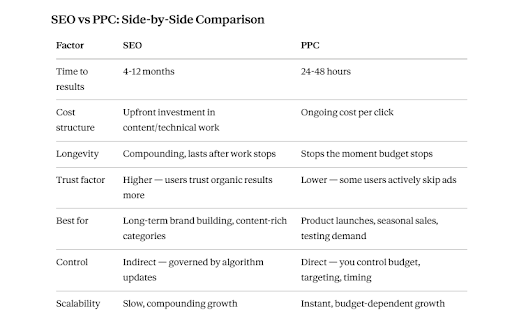
The catch: SEO takes time. Most small business websites in competitive categories need 4-8 months before rankings show meaningful movement, and 12+ months to compete for high-value keywords.
What PPC Actually Does for a Small Business
Pay-Per-Click advertising means you bid for placement on Google Search, Google Shopping, YouTube, Meta, or programmatic display networks and pay each time someone clicks your ad. Google Ads remains the dominant platform for Indian small businesses chasing search-based demand, though Meta Ads work better for visually driven, impulse-purchase categories.
PPC gives you:
- Immediate visibility your ad can appear at the top of search results the same day you launch a campaign
- Precise targeting by location, device, time of day, income bracket, and search intent
- Measurable spend every rupee is trackable to a click, a lead, or a sale
- Scalability on demand increase budget during a festive sale, pause it the week after
The catch: the moment you stop paying, the visibility stops. PPC is rented attention, not owned attention.
Cost Comparison: What Small Businesses in India Actually Spend
Numbers vary by industry and city, but here’s a realistic range for 2026:
SEO costs (India):
- Freelancer/small agency retainer: ₹15,000-₹40,000/month
- Mid-size agency for competitive categories: ₹50,000-₹1,50,000/month
- In-house hire (junior SEO executive): ₹25,000-₹40,000/month salary
PPC costs (India):
- Ad spend for a local service business: ₹15,000-₹50,000/month minimum to see meaningful data
- Ad spend for ecommerce: often ₹50,000+/month to compete on high-intent keywords
- Management fee (agency or freelancer): 10-20% of ad spend, or a flat retainer
The trap many small businesses fall into is comparing a ₹20,000 SEO retainer to a ₹20,000 PPC budget and expecting equal returns in month one. PPC returns are front-loaded. SEO returns are back-loaded but tend to overtake PPC in cumulative value by month 8-10 for most local service categories.
When PPC Makes More Sense
- You’re launching a new product or service and need to validate demand before investing in content
- You’re running a time-bound offer festive sale, limited inventory, event registration
- Your category has very low organic search volume, so there’s little SEO opportunity to capture
- You need cash flow now and can’t wait months for organic traffic to build
A Delhi-based D2C skincare brand, for instance, ran PPC exclusively for its first six months to test which products were converted before committing content budget to specific categories. That’s a legitimate use of PPC as a research tool, not just an acquisition channel.
When SEO Makes More Sense
- Your customers research before buying legal services, healthcare, education, financial planning
- You’re building a business for 3+ years, not a quick campaign
- Your category has strong, consistent search volume with room to rank
- You want to reduce dependency on rising ad costs, which have climbed steadily across Google Ads auctions in India over the past two years
A Bangalore-based interior design studio that invested in SEO-driven city and neighbourhood pages (e.g., “interior designers in Indiranagar”) now gets over 60% of its leads organically, with PPC reserved only for peak renovation season (March-June).
The 2026 Shift: AI Search Changes the Calculation
By mid-2026, a meaningful share of search queries in India were being answered directly inside Google’s AI Overviews, and increasingly through conversational tools like ChatGPT, Gemini, and Perplexity. This changes both channels:
- For SEO, ranking well now also means getting cited inside AI-generated answers which rewards clear, well-structured content, strong E-E-A-T signals, and schema markup, not just keyword density.
- For PPC, ad inventory within AI-powered search experiences is still evolving, meaning traditional search ads remain the more predictable paid channel for now.
Small businesses that build content clear enough to be quoted by an AI Overview are positioning themselves for visibility that neither pure PPC spend nor old-style SEO tactics can fully replicate. In the ongoing SEO vs PPC debate, AI search visibility is becoming an important factor that businesses can no longer ignore. This is one reason whitebunnie increasingly builds AI-search readiness into standard best digital marketing agency in Noida engagements rather than treating it as a separate service.
A Practical Approach: Use Both, Sequenced Correctly
Rather than picking a side, most successful small businesses in India run both channels in sequence:
- Months 1-3: Launch PPC to generate immediate leads and gather keyword/conversion data
- Months 2-6: Use PPC data to identify which keywords convert, then build SEO content around those exact terms
- Months 6-12: Gradually shift budget from PPC toward SEO as organic rankings mature
- Ongoing: Keep a smaller PPC budget for seasonal spikes, new launches, and competitive defence, while SEO carries the baseline traffic
Frequently Asked Questions
Is SEO better than PPC for a small budget?
If your monthly marketing budget is under ₹20,000, SEO generally stretches further because you’re not paying per click. But SEO needs several months to show returns, so make sure your business can sustain that runway before ruling out a small PPC test.
Can a small business do SEO and PPC at the same time?
Yes, and it’s often the smarter approach. Running both together lets PPC generate quick leads while SEO builds long-term visibility in the background, and the keyword data from PPC campaigns can directly inform SEO content priorities.
How long does SEO take to show results for a small business in India?
Most small businesses see initial ranking movement within 3-4 months and meaningful traffic and lead growth by month 6-9, depending on competition level in the category and city.
Does PPC stop working once you pause the budget?
Yes. PPC visibility ends almost immediately once ad spend stops, which is the core trade-off against SEO, where rankings (and the traffic they generate) can persist for months or years after the initial content and technical work is done.
The Bottom Line
There’s no universal winner between SEO and PPC only the right channel for where your business stands right now. If you need revenue this quarter, PPC buys you time. If you’re building something meant to last, SEO builds the foundation that PPC can’t replace.
The businesses that get this right in 2026 aren’t the ones choosing a side. They’re the ones sequencing both channels deliberately, using each to make the other more effective which is exactly the kind of strategy whitebunnie helps small businesses in India put into practice.
Be the first to comment on "SEO vs PPC: Which Is Better for Small Businesses in 2026?"