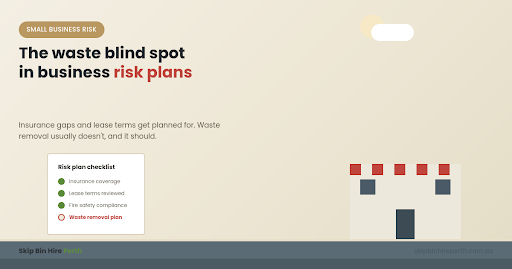
Small business owners spend a lot of time thinking about the risks that could genuinely hurt them, a burst pipe, a lease dispute, an insurance gap nobody noticed until it mattered. Waste removal rarely makes that list. It’s treated as background noise, something the cleaner or the landlord sorts out, not a business risk worth actually planning for.
That’s a mistake more often than people expect, particularly for businesses running shopfits, renovations, seasonal clear-outs, or anything involving physical stock and materials. Waste isn’t just rubbish. Mismanaged, it becomes a genuine operational and financial liability.
Where Waste Quietly Becomes a Business Risk
A retail fit-out that runs late because rubbish is blocking access for tradespeople isn’t logged as a waste problem. It’s logged as a delayed opening, with all the lost trading days that come with it. A café dealing with packaging, food waste and general operational rubbish without a proper system in place risks exactly the kind of council compliance issue that turns into a fine nobody budgeted for. A warehouse or small manufacturing operation storing waste materials incorrectly can create a genuine safety hazard, the kind that shows up in an insurance claim after something’s already gone wrong.
None of these start out looking like a waste problem. They start out looking like a delay, a compliance letter, or an incident report. The root cause tracing back to unmanaged waste often goes unnoticed until someone actually looks for the pattern.
The Cost That Doesn’t Show Up on an Invoice
Poor waste planning has a habit of hiding its real cost inside other costs. A business that loses a few trading days to a delayed fit-out doesn’t see “waste removal” on the ledger anywhere, it just sees lost revenue for the days the shop wasn’t open. A business fined for improper waste disposal doesn’t necessarily connect that fine back to a decision made months earlier not to bother setting up a proper system. A workplace injury caused by cluttered storage doesn’t get filed under “waste,” it gets filed under workers’ compensation.
This is exactly why waste removal is easy to overlook in a risk planning conversation. The consequences rarely wear a label that says where they actually came from.
What Proper Waste Planning Actually Looks Like
For most small businesses, this doesn’t need to be complicated. It mostly comes down to treating waste removal the same way you’d treat any other operational cost, planned in advance rather than handled reactively once it’s already a problem.
For a business undertaking a renovation, fit-out or seasonal clear-out, that means arranging a proper waste removal solution before the work starts, not scrambling once the rubbish has already piled up and started blocking access. A skip bin on-site during a fit-out or major clean-out tends to be far more efficient and far safer than ad hoc trips to a transfer station squeezed between other operational demands.
Providers like Skip Bin Hire Perth work with small businesses managing exactly this kind of project, offering a range of bin sizes suited to shopfits, office clear-outs and commercial renovations, with delivery timed around the business’s actual schedule rather than a generic booking window.
A Small Line Item With an Outsized Payoff
Getting waste removal right doesn’t require a big budget or a dedicated compliance officer. It requires treating it as a genuine part of project planning, estimated and arranged early, rather than an afterthought dealt with once things have already gone sideways.
For a business already thinking carefully about insurance gaps, lease terms and operational risk, waste removal deserves a place on that same list. It’s rarely the most expensive line item in a project, but it’s often the one that quietly determines whether that project runs on schedule, stays compliant, and avoids becoming a safety issue nobody saw coming.
The Bigger Picture
Risk planning tends to focus on the dramatic scenarios, the burst pipe, the lawsuit, the major insurance gap. Waste removal will never be as dramatic as any of those, and that’s exactly why it’s worth building into the plan deliberately. Left unmanaged, it has a habit of quietly causing the delays, fines and safety issues that a good risk plan is supposed to prevent in the first place.
Be the first to comment on "Why Commercial Waste Removal Deserves a Place in Every Small Business Risk Plan"