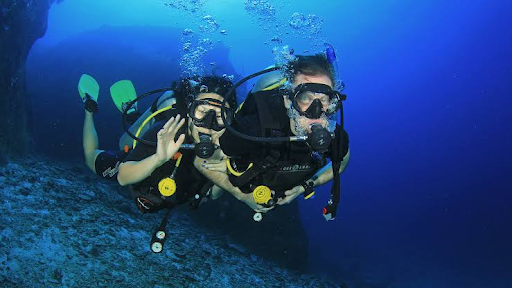
An hour off the coast of Koh Tao, a granite pinnacle breaks the surface of the Gulf of Thailand by roughly ten meters, giving barely a hint of what waits below. Sail Rock diving has built a reputation as the best the Gulf has to offer, and the site earns that status the moment divers drop beneath the surface and watch the pinnacle’s underwater terrain fall away to nearly forty meters. It’s not a subtle dive site. It’s dramatic, vertical, and built for divers who want more than a gentle reef drift.
What Sets Sail Rock Apart From a Typical Reef Dive
Most Koh Tao dive sites are built around coral gardens and gradual slopes, which is great for building skills but rarely dramatic. Sail Rock Thailand flips that script entirely. The pinnacle itself is a solid granite formation rising from deep water, meaning divers circle a genuine underwater mountain rather than a reef shelf. Western pinnacles at the site sit between eighteen and thirty-two meters, deep enough to require real buoyancy discipline and a head for depth, and the terrain shifts constantly as you move around the formation. Groupers patrol the rock’s crevices, barracuda school in tight, hypnotic formations in the blue water off the pinnacle’s edge, and the sheer scale of the rock makes every dive here feel more like an expedition than a routine outing.
The Chimney: Sail Rock’s Signature Swim-Through
No description of this site is complete without The Chimney, a hollow vertical channel that has become the defining feature of Sail Rock dive site itineraries. Divers enter the channel at around sixteen meters and ascend gradually through the rock itself, exiting near six meters on the other side. It’s a genuinely unusual formation, a natural swim-through carved into the granite rather than built around coral, and the sensation of ascending through solid rock with shafts of light filtering down from above is something few other sites in the region can replicate. Because of the depth and the ascent required, this route is best suited to Advanced Open Water certified divers, who have the training and comfort level to manage the transition confidently. Trips to Sail Rock diving sites are typically run as full-day excursions with multiple dives, giving divers time to properly explore both The Chimney and the outer pinnacles.
Timing a Trip Around Whale Sharks
Part of what makes diving Sail Rock genuinely special is timing a visit around its seasonal visitors. Whale sharks pass through the area roughly during February through April and again in September and October, and while no sighting is ever guaranteed with a wild animal, divers who plan trips around these windows improve their odds considerably. Even without a whale shark cruising past, the resident population of groupers and barracuda, combined with the pinnacle’s sheer topography, makes the site worth the boat ride on any given day of the year, since Gulf water stays warm enough for comfortable diving in every season.
Why Advanced Divers Rate It Among the Best in Thailand
Ask experienced divers across Southeast Asia to name the top dive sites in the region, and this pinnacle comes up constantly, often ranked among the best dive sites Thailand has to offer regardless of location. Part of that reputation comes from the depth range and terrain variety packed into a single site, and part of it comes from simple rarity. There aren’t many places where a diver can circle a granite pinnacle, swim vertically through a rock formation, watch barracuda schooling in open water, and potentially cross paths with a whale shark, all within a single one-hour boat trip from a dive hub like Koh Tao.
How Sail Rock Compares to Other Gulf Sites
Divers who’ve spent time on Koh Tao’s more typical reef sites, sloping coral gardens with a gentle maximum depth, often describe their first Sail Rock dive as a genuine shift in scale. Where a standard reef dive rewards patience and close observation of small reef life, Sail Rock rewards comfort with depth, current, and open water. That doesn’t make it inaccessible, plenty of newly Advanced divers handle it well with a good guide, but it does mean treating it as a step up rather than just another stop on a multi-site day trip. Operators typically brief this distinction clearly before departure, since managing expectations matters as much as managing air consumption on a site this dramatic.
Planning Your Own Trip to the Pinnacle
Booking a trip here isn’t complicated, but a little preparation goes a long way. Because much of the site’s best terrain sits below eighteen meters, and The Chimney itself starts at sixteen, divers should hold an Advanced Open Water certification or dive with a guide experienced in briefing less-certified divers through the shallower sections. Checking seasonal whale shark windows before booking, packing for variable current, and confirming boat departure times with a local operator all help turn a good day of diving into the kind of dive that gets talked about for years afterward. Most operators run Sail Rock as a full-day trip departing Koh Tao in the morning, which also leaves enough surface interval time between dives to properly recover from the depth before heading back to shore.
Be the first to comment on "Why Sail Rock Diving Is Thailand’s Most Iconic Underwater Experience"