Smile whitening is often associated with younger patients and pre-event preparation. In practice, it’s one of the most consistently rewarding cosmetic improvements available across a wide range of ages and presentations — and the patients who benefit most are frequently those who assumed they weren’t candidates.
Here’s a clear, honest picture of who professional whitening suits, what the process involves, and what patients can realistically expect.
Who Benefits Most From Professional Whitening
The strongest candidates for professional whitening are patients whose discolouration is primarily extrinsic — accumulated staining from dietary habits, tobacco, and the gradual effect of years of normal use. For these patients, bleaching treatment addresses the cause directly and produces predictable, significant improvement.
Age is not a limiting factor. Adults in their forties, fifties, and beyond with predominantly surface staining often achieve some of the most gratifying results — because the contrast between their starting point and their post-treatment result is larger, and because a brighter smile has a noticeably rejuvenating effect on overall appearance.
Patients with active decay or gum disease need to have those issues addressed before whitening begins — not because whitening is contraindicated for them permanently, but because treatment on an unhealthy mouth is less comfortable and less effective. A brief professional assessment identifies anything that needs to be addressed first.
The In-Office Experience
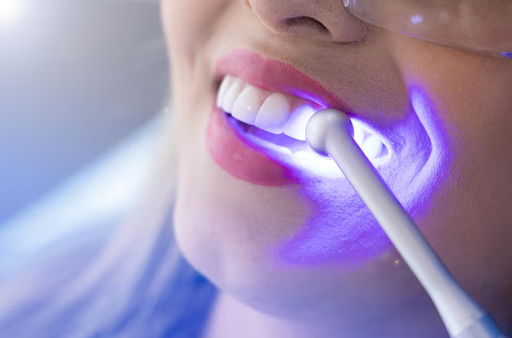
In-office whitening is performed in a single dental appointment, typically lasting forty-five minutes to one hour of active treatment time. The dentist or hygienist places protective material on the gum tissue, applies the professional-grade bleaching gel to the tooth surfaces, and monitors the treatment as it progresses.
The immediate result is visible at the end of the appointment. Most patients achieve a meaningful improvement — several shades lighter than their starting point — in a single session. The teeth may feel slightly sensitive for twenty-four to forty-eight hours following treatment; this is normal and resolves without intervention for the majority of patients.
Custom Take-Home Treatment
Custom take-home whitening involves fabricating trays from a precise impression of the patient’s teeth, which are then used at home with professional-grade bleaching gel. Treatment is typically performed overnight or for several hours per day, over a period of two to four weeks.
The take-home approach offers two significant advantages over in-office treatment: the patient controls the degree of whitening achieved, stopping when they reach their desired result; and the trays are retained for maintenance use, making it easy to touch up results periodically without a full treatment course.
Many patients find the gradual nature of take-home treatment more comfortable than the accelerated in-office approach — particularly those with a history of sensitivity.
What Happens With Different Types of Staining
Extrinsic staining, as noted, responds well to bleaching. But not all tooth discolouration falls into this category, and professional assessment identifies when a different approach is more appropriate.
Teeth affected by tetracycline antibiotics during development present with grey or banded discolouration that bleaching can partially improve but rarely resolves completely. For significant staining of this type, porcelain veneers typically produce more satisfying outcomes.
Fluorosis — white spots or brownish mottling from excessive fluoride exposure during development — can be partially improved by bleaching but may require microabrasion, veneers, or bonding for complete resolution.
Teeth that are dark primarily because dentine is showing through thinned enamel have a limited ceiling for whitening improvement. This is best identified before treatment rather than after investment in a product that won’t address the underlying cause.
Combining Whitening With Other Cosmetic Work
Whitening is most effectively positioned as the foundation of cosmetic dental work rather than an isolated treatment. For patients pursuing veneers, bonding, or crown replacements on front teeth, whitening should be completed first — because the colour of any new restoration will be matched to the whitened tooth baseline.
Performing whitening after colour-matched restorations are placed creates a mismatch between natural teeth and existing dental work. Sequencing whitening first and matching restorations to the improved baseline produces a consistent, aesthetically coherent result.
For Colorado Springs patients ready to explore their options, the range of professional smile whitening solutions in Colorado Springs at Robison Dental includes in-office treatment, custom take-home systems, and combined approaches — with the professional assessment that ensures the right solution is matched to each patient’s specific presentation and goals.
FAQs
Q: Is professional whitening safe for older adults?
Yes. There’s no upper age limit for whitening, and many older adults are excellent candidates. The assessment process confirms suitability based on the health of the teeth and gums, not age.
Q: How many shades can teeth whiten with professional treatment?
Results vary, but most patients achieve an improvement of four to eight shades on the standard dental shade guide. The ceiling depends on individual enamel characteristics and staining type.
Q: What’s the difference between whitening and porcelain veneers for improving smile appearance?
Whitening changes the colour of existing tooth enamel and is the least invasive approach. Veneers cover the entire visible surface of the tooth and can change colour, shape, and texture simultaneously — producing more dramatic and comprehensive results at a higher cost and with irreversible tooth preparation. The right choice depends on which aspect of smile appearance needs improvement and the extent of change desired.
Be the first to comment on "A Brighter Smile at Any Age: What Professional Whitening Involves and Who It’s Right For"