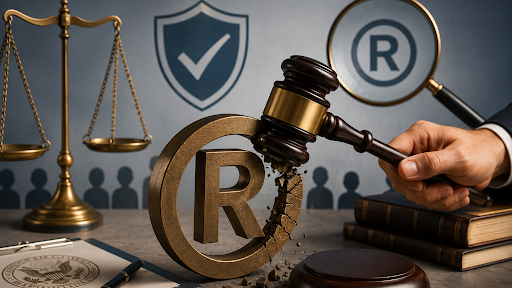
Your brand name or logo is not permanently locked down once the United States Patent and Trademark Office (USPTO) issues a trademark registration certificate. You are not completely immune to outside threats. Under the federal Lanham Act, any registered trademark remains vulnerable to third-party challenges if specific legal criteria are met. Securing a trademark is the first step; you must meet ongoing maintenance requirements.
This article details the exact timelines, legal grounds, and court venues involved in the revocation of a trademark.
Pre- vs. Post-Registration
A trademark is vulnerable to challenges during the following two distinct phases:
The Pre-Registration Window
A trademark must pass a public review phase before it is officially registered. A trademark examining attorney at the USPTO approves an application, and the USPTO publishes the mark in its Official Gazette. Anyone within the next 30 days can file a formal Notice of Opposition to block the registration if they believe it would damage their business.
The Post-Registration Window
Your mark proceeds to official registration if no one opposes it during these 30 days. Once the mark is officially registered, it is now open to a Petition for Cancellation.
Years 1 through 5
A competitor can file a petition to cancel your mark during these years. One common ground in this petition is “likelihood of confusion” with their prior trademark.
Post-Year 5 (Incontestability)
You can file a Section 15 affidavit to achieve incontestable status after five years of continuous commercial use. The incontestable status protects your mark from being canceled based on claims of prior use or descriptive weakness. However, your mark is still not immune to everything.
If a competitor can prove fraud, complete abandonment, or other extreme violations, then they can cancel your mark.
The 4 Legal Grounds for Revocation
Ground 1: Abandonment (Non-Use)
You abandon your legal right if you stop using your mark in commerce with no intent to resume. According to the Lanham Act, if you do not use your mark for three consecutive years, it is presumed abandoned. It is a major risk as a competitor can now file a petition for the total cancellation of your mark.
Ground 2: Genericism (Loss of Distinctiveness)
If your brand becomes a common everyday noun for the product, it loses trademark protection through genericide. ‘Escalator’ is a generic term in the United States after losing trademark protection due to genericide.
Aspirin is a trademark owned by Bayer that is generic in the United States, United Kingdom, and France, but it remains protected or enforceable in some other jurisdictions, including Germany. You can help prevent genericide by using your brand name as an adjective, such as “Kleenex® tissues.” Avoid using your trademark as a noun or verb.
Ground 3: Fraud on the USPTO
Fraud on the USPTO requires a knowingly false, material statement made with intent to deceive, not just any false statement. Mistakes, negligence, or overbroad claims alone are not automatically “fraud.” For example, you over-claim items in a declaration of use. You claim your mark is actively used on 10 types of apparel, but you are selling only T-shirts. The USPTO or a federal court will cancel your entire registration, not just the fraudulent parts.
Ground 4: Likelihood of Confusion
If you are applying for a new trademark, make sure it does not closely resemble an existing registered mark when used on similar goods or services. The owner of the existing trademark can claim that your trademark can confuse their customers. However, the owner of the existing trademark must challenge it within five years of registration.
Where Challenges are Handled
The Trademark Trial and Appeal Board (TTAB)
The TTAB has a panel of administrative judges who review evidence and legal briefs to decide the right to federal registration. It has the power to sustain an opposition, refuse a pending application, or completely cancel an existing trademark registration.
However, the TTAB cannot award monetary damages, attorney’s fees, or issue injunctions against use of a mark.
Federal District Court
A business must file a lawsuit in a federal district court to stop a competitor from physically using a confusingly similar mark or recover lost profits.
- A trademark owner can sue for infringement. The federal court can force the competitor to stop using the mark immediately and award financial damages for lost profits.
- A targeted business can seek a declaratory judgment against the trademark owner in federal court. For this, they must request a declaratory judgment from the court stating that their business does not infringe or that the trademark is invalid.
Speak to an expert offering copyright and trademark services if your mark is at risk of cancellation or revocation.
Be the first to comment on "Can an Approved Trademark Be Challenged or Revoked?"