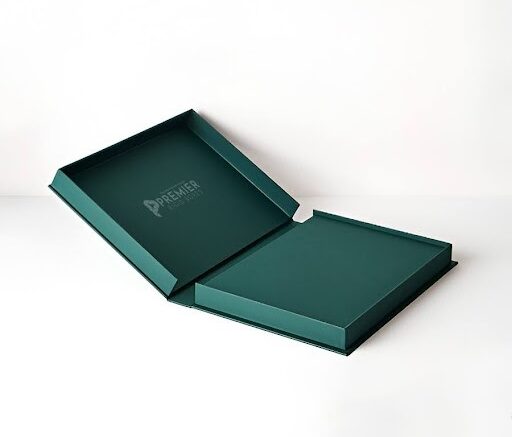
A print shop owner I spoke with a while back said something that’s stuck with me since. He said most of the complaints he gets about booklet rigid boxes aren’t actually about the box itself they’re about problems nobody caught until the first batch was already sitting in a warehouse. A hinge that won’t hold after the tenth open. A magnet slightly off-center. Pages that don’t sit flush against the interior panel. Small things, individually. Together, they’re the reason a genuinely good product idea ends up looking like an amateur one on a shelf.
Booklet rigid boxes are a specific, tricky category. Part packaging, part functional object they open like a book, usually hold something layered or informational inside, like a fragrance set, a sample collection, or a multi-panel product display. That hybrid nature is exactly where most of the recurring problems live.
The Hinge Is Almost Always the First Thing to Go
If there’s one component worth obsessing over before anything else, it’s the hinge. A booklet box lives and dies by how it opens, and a hinge that’s slightly too tight or too loose ruins the entire experience regardless of how good the print or finish looks. Too tight, and customers force it, which usually tears the covering material along the fold within the first few uses. Too loose, and the box never closes flush again after the first open, which makes the whole thing feel cheap almost immediately.
The fix is rarely about the hinge material itself it’s about testing it under repeated use before committing to a full production run. A hinge that feels fine on the fifth open can behave completely differently by the fiftieth. Getting a working prototype through fifty or so open-close cycles before finalizing the design catches problems no spec sheet will ever reveal.
Interior Fit Problems Nobody Notices Until Assembly
A surprisingly common issue: the interior insert, tray, or divider gets designed against a flat digital mockup, then doesn’t actually sit right once the box is folded and closed in real life. Rigid board has a small but real thickness that digital design tools don’t always account for properly, and that thickness adds up fast across multiple folds and layers.
The workaround is building the interior fit against a physical sample of the actual folded box, not a flat rendering. It sounds obvious once it’s said out loud, but it’s one of the most frequently skipped steps, mostly because it takes an extra production cycle that people are impatient to skip.
Print and Finish Cracking Along the Fold
This one shows up constantly and it’s almost entirely preventable. A glossy or heavily laminated finish applied straight across a fold line tends to crack or whiten slightly the first time the box is opened, because the coating doesn’t flex the same way the board underneath does. It looks like a manufacturing defect even when the box itself is structurally fine.
Scoring the fold line properly before lamination, and choosing a slightly more flexible coating specifically along the hinge area, solves most of this. It’s a small technical adjustment that a lot of suppliers won’t mention unless specifically asked, so it’s worth bringing up directly during the quoting process rather than assuming it’s already been accounted for.
Weight Distribution That Makes the Box Feel Unbalanced
Booklet boxes often hold uneven contents heavier product on one side, lighter inserts or literature on the other and that imbalance becomes obvious the second someone picks the box up. A box that tips or feels lopsided undercuts the premium impression the format is usually going for in the first place.
Balancing this usually means adjusting board thickness asymmetrically between the two panels, or adding a small amount of weighted material to the lighter side. It’s a subtle fix, but it’s the difference between a box that feels considered and one that feels like an afterthought.
Corner and Edge Wear Nobody Plans For
Booklet boxes get handled differently than standard rigid boxes, opened and closed repeatedly, often passed between people, sometimes displayed open on a shelf. That repeated handling wears down corners and edges faster than a typical one-time-open rigid box would ever experience. A foldable rigid box built with the same corner treatment as a standard gift box often shows visible wear within a couple weeks of regular handling.
Reinforced corner lamination, or a slightly thicker board specifically at the corners even if the rest of the panel stays standard thickness, solves most of this without adding much to the overall cost.
Where This Usually Goes Wrong From the Start
Rushing straight from digital design to full production without a physical prototype that’s actually been opened and closed dozens of times. Assuming a supplier will automatically account for fold-line coating issues without it being discussed directly. And underestimating how differently a booklet format needs to be tested compared to a standard one-piece rigid box, since most of the usual rigid packaging checklists simply don’t account for a hinge that has to survive repeated use.
Final Thoughts
Booklet rigid boxes fail in small, specific ways that rarely show up until real units are already in someone’s hands which is exactly why they’re worth testing more thoroughly than a standard box before committing to a full run. Most of the fixes here are inexpensive and simple once identified. The real cost comes from not catching them early, when a five-minute adjustment during prototyping turns into a reprint of the entire order after launch.
Frequently Asked Questions
How many times should a booklet box hinge be tested before production?
Somewhere around fifty open-close cycles on a physical prototype is a reasonable benchmark, since problems that don’t show up in the first few uses often appear well before that number.
Why does my booklet box crack along the fold after the first open?
This usually happens when a glossy or laminated finish is applied straight across the score line without adjustment. A more flexible coating specifically at the hinge typically resolves it.
Is it normal for a booklet box to feel unbalanced when picked up?
It shouldn’t be ignored. Uneven content weight combined with a symmetrical design is the usual cause, and it’s fixable by adjusting board thickness between the two panels.
Be the first to comment on "Little Known Ways to Rid Yourself of Booklet Rigid Box Problem"